
Plants
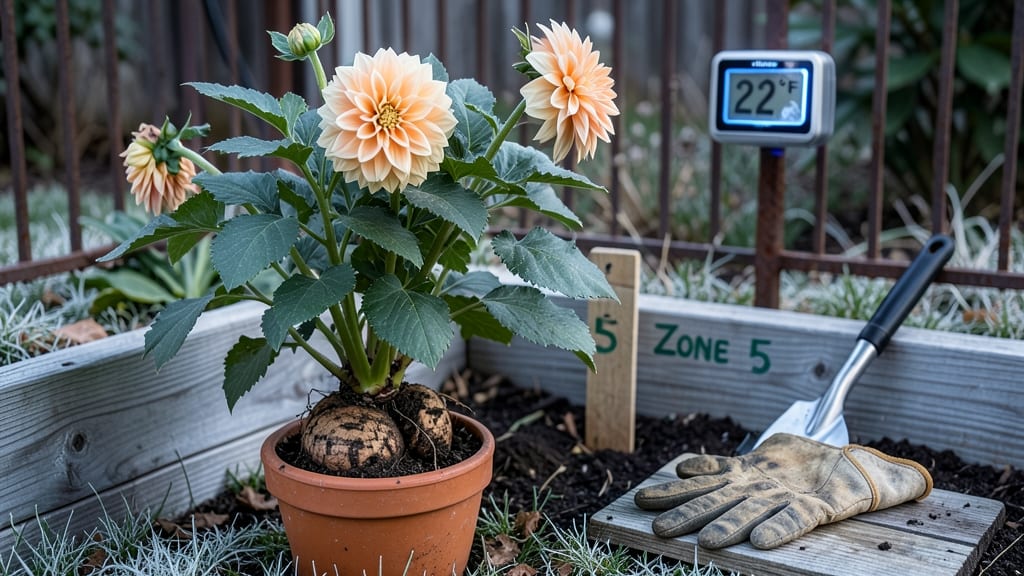
Dahlias aren't reliably perennials in Zone 5 without protection, since their tubers and foliage freeze when temperatures drop below 20°F. Most varieties die back completely each winter, requiring either digging up tubers or heavy mulching to survive the cold.
In Zone 5's harsh winters, dahlia tubers—where the plant stores energy—struggle to survive underground without protection. 🌱 The real issue isn't just the air temperature but the soil freezing solid, which kills dormant tubers.
Unlike hardy perennials like peonies or coneflowers that withstand Zone 3-4 winters, dahlias need special care to persist beyond one growing season. Many gardeners treat them as annuals unless they're willing to invest time in winter storage or heavy mulching techniques.
That said, some late-season varieties like 'Café au Lait' or 'Bishop' show better cold tolerance, but even these often need extra insulation. The key is acting early—before the first hard frost—to either mound soil around the base or dig up and store tubers in a cool, dry place.
Without intervention, most dahlias simply won't make it through Zone 5 winters.
💡 In This Article
- Zone 5 Winter Survival Challenges for Dahlias
- Protecting Dahlias in Zone 5: Mulching and Storage Methods
Zone 5 winter survival challenges for dahlias
The core challenge for dahlias in Zone 5 stems from their tropical origins—most varieties evolved in Mexico and Central America where winters never drop below 40°F. Their survival hinges on the tuber, a swollen underground stem that stores nutrients.
When soil temperatures fall below 20°F, these tubers freeze solid, causing irreversible cellular damage. Unlike hardy perennials like peonies (Zone 3) or coneflowers (Zone 4), dahlias lack natural frost resistance in their foliage or root systems.
What makes this worse is the timing: dahlias' top growth dies back with the first frost, but the tuber remains active until soil temperatures drop below 32°F. In Zone 5, this happens by late fall, giving gardeners just 4-6 weeks to protect tubers before winter sets in.
The soil's insulating properties are also critical—wet, heavy clay soils freeze faster than well-draining loam, accelerating tuber death. 🌡️
This biological limitation explains why most gardeners treat dahlias as annuals in Zone 5. Even varieties labeled "cold-hardy" (like 'Kelvin Flood' or 'Black Narcissus') rarely survive unprotected winters.
The USDA's cold hardiness ratings for dahlias typically max out at Zone 8-9, meaning Zone 5's -10°F to -20°F winters are simply too severe for their natural defenses.
For comparison, consider peonies—another tuberous perennial—but their roots contain antifreeze proteins that protect cells down to -30°F. Dahlias lack these adaptations, making them vulnerable even when other perennials thrive.
The key difference lies in cellular membrane composition: peony cells have higher unsaturated fat content, preventing ice crystal formation that destroys dahlia tubers.
What most gardeners overlook is the role of soil microbes during winter. Beneficial fungi that help break down dead plant matter become inactive below 32°F, leaving tubers more susceptible to rot if not properly insulated.
This microbial shutdown creates a double threat: frozen tubers AND potential rot from trapped moisture. 🌱
Understanding these biological constraints helps explain why dahlias require active intervention in Zone 5. Without protection, their survival rate drops to nearly 0%—a stark contrast to native perennials that have evolved alongside local climates for millennia.
The solution lies in mimicking their natural tropical environment through mulching or storage techniques that maintain stable temperatures above 32°F.