
Plants
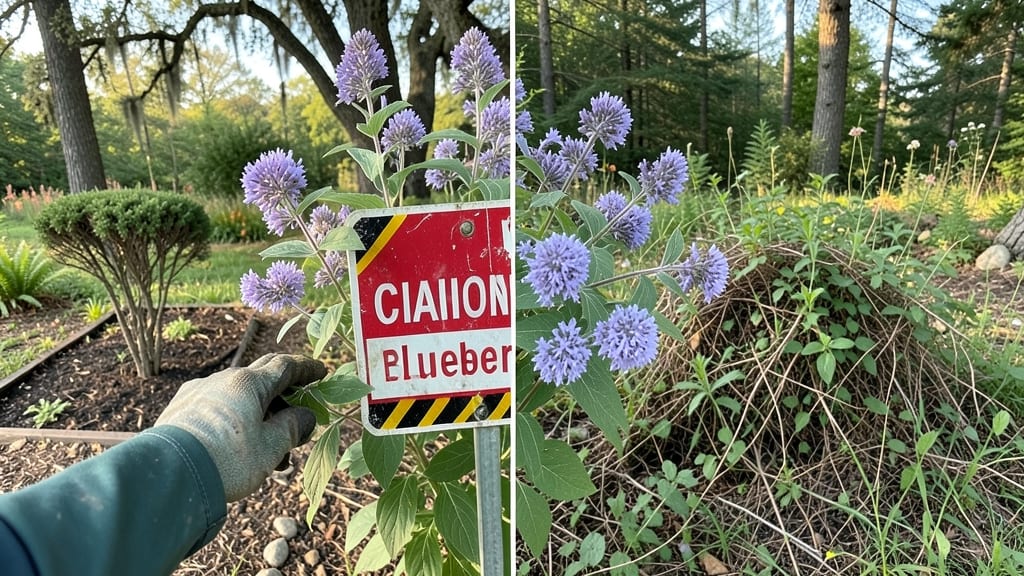
The bluebeard plant (Caryopteris × clandonensis) is highly invasive, spreading rapidly through underground runners and prolific seed production. Left unchecked, it can overtake garden spaces and natural habitats within just 2-3 years, crowding out native plants and disrupting ecosystems.
The bluebeard plant's invasive nature stems from its dual spread mechanisms: its extensive root system sends out underground shoots that create new plants, while its tiny seeds disperse easily via wind and wildlife. 🔥 This makes it particularly troublesome in regions with mild winters, where it thrives year-round.
Gardeners often underestimate its growth rate—what starts as a single plant can become a dense thicket within a growing season if not managed properly.
Containment requires consistent effort, as even small fragments of root can regenerate. The plant's adaptability to various soil types and drought tolerance further exacerbates the problem, making traditional control methods less effective without a strategic approach.
💡 In This Article
- How Bluebeard Plant Spreads: Growth Habits and Aggressive Traits
- Effective Bluebeard Plant Control: Chemical and Natural Methods
How bluebeard plant spreads: growth habits and aggressive traits
The bluebeard plant's invasion begins with its hidden underground network. This species develops rhizomatous roots that spread horizontally up to 3-5 feet per year under ideal conditions. These roots produce new shoots at nodes, creating dense colonies that can smother surrounding vegetation.
The growth rate rivals aggressive spreaders like mint (2-3 feet annually) and bamboo (3-4 feet annually), though without bamboo's vertical dominance.
Above ground, the plant's prolific seed production accelerates its spread. A single mature plant can release 500-1,000 tiny seeds per season, each weighing less than 0.001 grams. Wind carries these seeds efficiently, while birds and small mammals disperse them through their droppings.
The seeds remain viable for 2-3 years in soil, creating a persistent seed bank that ensures continuous regeneration.
The plant's adaptability makes it particularly challenging. Bluebeard thrives in USDA Zones 5-9, tolerating poor, rocky soils and surviving drought conditions through deep root penetration.
Its drought resistance allows it to outcompete native plants during dry spells, while its ability to grow in full sun to partial shade gives it versatility in various garden settings. This adaptability explains why it's classified as invasive in 12 U.S. states and several Canadian provinces.
What makes bluebeard especially problematic is its two-pronged invasion strategy. While many invasive plants rely on either seed dispersal or root spread, bluebeard combines both methods effectively. The rhizomes create immediate ground cover, while the seeds ensure long-term persistence even after removal attempts.
This dual approach means gardeners must address both above-ground growth and below-ground roots simultaneously for effective control.
Visually, you can identify aggressive spread by looking for clumps of identical plants growing in a circular pattern, indicating rhizome expansion. The plant's lavender-blue flower clusters appear in late summer, but by then, the damage is often already done as the roots have established new growth points.
The aromatic foliage, while attractive, masks the plant's true invasive nature until it's too late for easy removal.
For comparison, consider how bluebeard outpaces other common garden perennials. While daylilies spread 1-2 feet annually via rhizomes, bluebeard's combination of rapid rhizome growth and prolific seeding makes it 3-5 times more aggressive in suitable conditions.
This growth rate explains why gardeners often find themselves battling established patches within just 1-2 growing seasons after initial planting.