
Planting
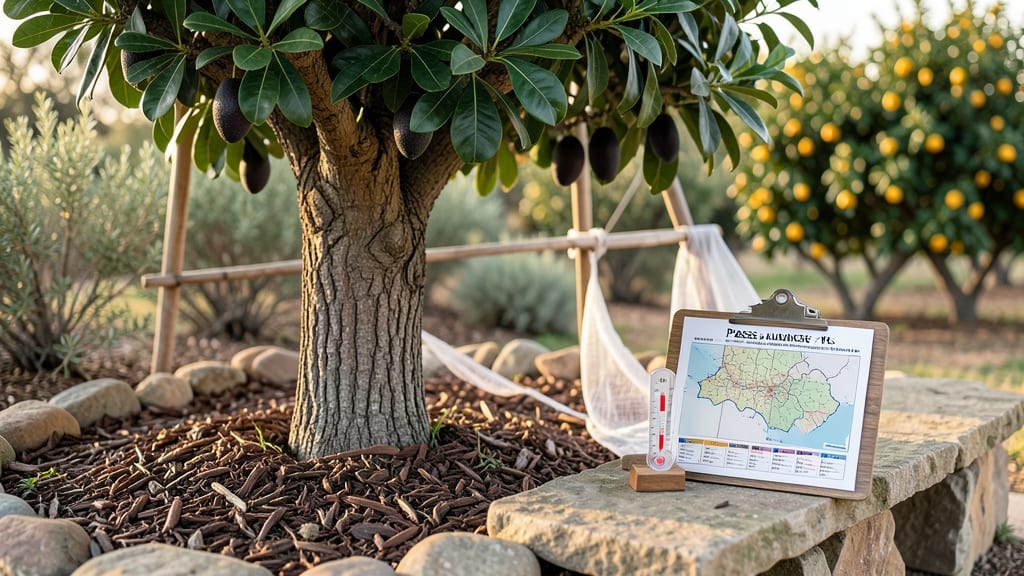
Hass avocado trees grow best in USDA hardiness zones 9b through 11, where temperatures rarely drop below 28°F (-2°C). Young trees can't tolerate cold below 32°F (0°C), while mature trees might survive brief dips to 25°F (-4°C). Any frost or extended cold snaps under 28°F can severely damage or kill the tree.
Understanding these temperature thresholds helps you choose the right location for your Hass avocado. 🌱 In warmer zones, trees thrive with minimal protection, but gardeners in marginal zones (like 8b–9a) need to take extra precautions.
The key difference between young and mature trees lies in their root systems—mature trees develop deeper roots that insulate them better against cold snaps. I always recommend planting in well-drained soil and using windbreaks to create a microclimate that mimics the tree's ideal growing conditions.
For those in cooler climates, consider growing Hass avocados in containers and moving them indoors during winter months. This method gives you flexibility to protect the tree from sudden temperature drops.
If you're committed to outdoor planting, focus on gradual acclimation—exposing the tree to slightly cooler temperatures over time can improve its cold tolerance, though it won't match the resilience of trees grown in their native zones.
💡 In This Article
- Hass Avocado Cold Sensitivity: How Temperature Affects Growth
- Protecting Hass Avocados in Marginal Zones: Practical Solutions
Hass avocado cold sensitivity: how temperature affects growth
The Hass avocado's cold sensitivity stems from its tropical origins, where temperatures rarely dip below 50°F (10°C). At the cellular level, cold stress triggers a cascade of damage: water inside plant cells begins to freeze, causing ice crystals to form and rupture cell membranes.
This process, called chilling injury, disrupts nutrient transport and leads to brown, mushy spots on leaves and stems—visible within 24-48 hours of exposure to 32°F (0°C) or lower. 🌡️ The tree's metabolic processes slow dramatically below 50°F (10°C), with photosynthesis dropping by up to 50% for every 10°F (5.5°C) decrease.
Roots are particularly vulnerable because they lack the protective bark of stems and leaves. When soil temperatures fall below 55°F (13°C), root growth halts completely, and prolonged exposure to 40°F (4°C) can kill root tips in as little as 72 hours.
This is why mature trees—with deeper, more established root systems—can tolerate brief dips to 25°F (-4°C) better than young trees, whose shallow roots freeze more easily. The foliage also suffers, with leaves curling and dropping when temperatures hit 32°F (0°C), though the tree may recover if warmth returns quickly.
Prolonged cold exposure compounds the damage. While a single night at 28°F (-2°C) might cause superficial injury, sustained temperatures below 32°F (0°C) for more than 4-6 hours can lead to irreversible damage.
The tree's recovery threshold depends on how deeply the cold penetrated: surface damage (like leaf burn) may heal with warm, sunny days, but internal damage to roots or cambium layers often proves fatal.
This is why gardeners in marginal zones (like zone 9a) must act swiftly during cold snaps—delaying protection by even 12 hours can mean the difference between recovery and tree death.
Another critical factor is the speed of temperature change. Hass avocados handle gradual cooling better than sudden drops.
For example, a slow descent from 50°F (10°C) to 35°F (2°C) over 24 hours allows the tree to adjust its internal chemistry, while a rapid plunge from 60°F (15°C) to 28°F (-2°C) in 2 hours can cause lethal stress.
This is why microclimates—like those created by windbreaks or mulch—play such a vital role in protecting Hass avocados from cold.
What most people don't realize is that the tree's cold tolerance improves slightly with age, but never to the point of surviving harsh winters. Even mature trees in zone 10a can suffer damage if a 20°F (-7°C) frost hits, though the effects may be less severe than on younger trees.
The key to minimizing risk is understanding these thresholds and preparing for cold events before they occur—whether through mulching, windbreaks, or container growing. 🌿
For those in zone 9b or warmer, the focus should be on preventing chilling injury rather than outright freezing. Even temperatures in the 40s°F (4-9°C) can stress the tree, leading to reduced fruit production or poor-quality avocados.
This is why many commercial growers in these zones use overhead irrigation during cold nights—water releases heat as it freezes, creating a 3-5°F (1.5-3°C) buffer around the tree.