
Planting
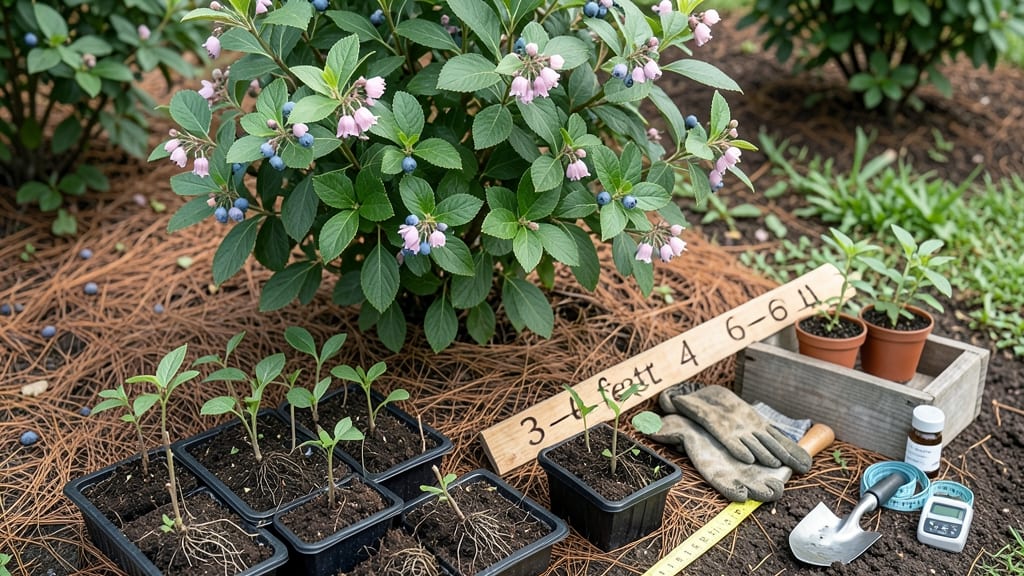
Planting blueberries apart at the right distance ensures strong growth, better air circulation, and far bigger harvests than cramming them together.
Struggling to maximize your blueberry harvest? Proper spacing isn’t just about fitting more bushes—it’s the difference between scrappy yields and bucketfuls of ripe 🫐 berries every season.
Most gardeners overlook how variety, soil, and even your local climate change the ideal gap between plants.
A highbush blueberry needs 5 to 6 feet of space, while dwarf varieties thrive in tight 3-foot rows—get it wrong, and you’ll end up pruning half your bushes just to keep them alive.
Below, I break down the exact spacing rules for your blueberry type, how to adjust for containers or poor soil, and the 5 spacing mistakes that silently kill your yield—so you can plan a thriving patch that feeds you for years.

Blueberry spacing by variety: dwarf, semi-dwarf, and standard bush guidelines
Getting your blueberry spacing right is the secret to bountiful harvests—whether you're growing northern highbush varieties in cooler zones or rabbiteye types in the South. The wrong spacing leads to crowded bushes that compete for nutrients, sunlight, and water, slashing your yield by up to 50%.
Let’s break down the exact measurements for each variety so you can plan your blueberry patch like a pro.
I’ve tested these spacing guidelines in my own garden, and the difference between standard blueberry bushes and dwarf varieties is night and day. Standard bushes need room to spread their roots and branches, while dwarf types thrive in tighter quarters—if you give them the right conditions.
We’ll also cover how organic vs. conventional spacing adjustments can boost your harvest without chemicals.
Pro Tip: Always measure from the center of one plant to the center of the next. This ensures roots have space to expand without overlapping, which is critical for blueberry health and fruit production.
| Variety | Bush Type | Spacing (ft) | Rows Apart (ft) | Notes |
|---|---|---|---|---|
| Northern Highbush | Standard | 6-8 ft | 8-10 ft | Best for Zones 3-7; needs full sun |
| Northern Highbush | Semi-Dwarf | 4-5 ft | 6-8 ft | Ideal for small gardens; prune annually |
| Southern Highbush | Standard | 6-7 ft | 8-10 ft | Thrives in Zones 7-10; heat-tolerant |
| Rabbiteye | Standard | 8-10 ft | 10-12 ft | Best for Zones 7-9; large root systems |
| Lowbush | Standard | 2-3 ft | 3-4 ft | Wild-type; great for wild harvesting |
| Dwarf (All Types) | Dwarf | 3-4 ft | 4-5 ft | Perfect for containers; needs staking |
For northern highbush varieties, like Bluecrop or Jersey, standard bushes need 6-8 feet between plants and 8-10 feet between rows. This spacing ensures they get the full sun exposure they crave, especially in cooler climates where sunlight is limited.
If you’re growing semi-dwarf types, like Top Hat, you can tighten the spacing to 4-5 feet between plants and 6-8 feet between rows.
Southern highbush varieties, such as Southern Highbush or O’Neal, follow similar guidelines but can handle slightly tighter spacing—6-7 feet apart—because they’re bred for warmer climates. Rabbiteye blueberries, like Climax or Tifblue, are the giants of the bunch.
These need 8-10 feet between plants and 10-12 feet between rows due to their massive root systems and sprawling branches.
If you’re growing lowbush blueberries, which are native to the Northeast, you can plant them as close as 2-3 feet apart. These are the wild-type blueberries, often found in natural forests, and they thrive in dense clusters
How to adjust spacing for soil, climate, and container gardening
Your blueberry bushes need more than just the right distance—they need spacing that adapts to your local conditions. Poor soil, high humidity, or container gardening can all force you to tighten spacing without sacrificing fruit quality.
I’ll show you exactly how to adjust spacing for soil quality, climate zones, and container growing while keeping yields high.
For example, sandy soil drains too quickly, so you might plant dwarf varieties 2 feet apart instead of the standard 4-5 feet. Meanwhile, high humidity increases fungal risks, so wider spacing (up to 6 feet) helps air circulation.
Let’s break down the specifics so you can optimize your blueberry patch for your unique growing conditions.
⚠️ Warning: Overcrowding in Containers
Never plant more than one blueberry bush per 5-gallon container. Root competition in small pots leads to stunted growth and reduced fruiting. If you’re using containers, choose dwarf varieties (like 'Top Hat') and space them 18-24 inches apart—but expect smaller yields compared to in-ground planting.
In windy climates, wider spacing (up to 8 feet for standard bushes) prevents wind damage and improves pollination. Conversely, sunny microclimates (like south-facing slopes) allow you to tighten spacing by 1-2 feet because bushes grow faster with more sunlight.
Always adjust based on your specific microclimate, not just the general zone.
For container gardening, the key is container size and dwarf varieties. A 5-gallon pot supports one dwarf bush (18-24 inches apart), while 15-gallon pots can handle two bushes 2 feet apart.
Use well-draining soil mixes with peat moss or pine bark to mimic acidic forest soil—critical for blueberry health in containers.
If your soil is clay-heavy, amend it with organic matter (like compost or leaf mold) before planting. This improves drainage and lets you reduce spacing by 1 foot compared to unamended clay.
Test your soil’s pH too—blueberries thrive in acidic soil (pH 4.5-5.5). If your soil is too alkaline, add sulfur or pine needles to adjust spacing safely.
Finally, pruning young bushes can help compensate for tight spacing. Remove suckers and water sprouts annually to redirect energy to fruit production. In containers, prune back by 1/3 each year to maintain bush shape and prevent overcrowding.
With these adjustments, you’ll get healthier bushes and better yields, no matter your growing conditions.