
Planting
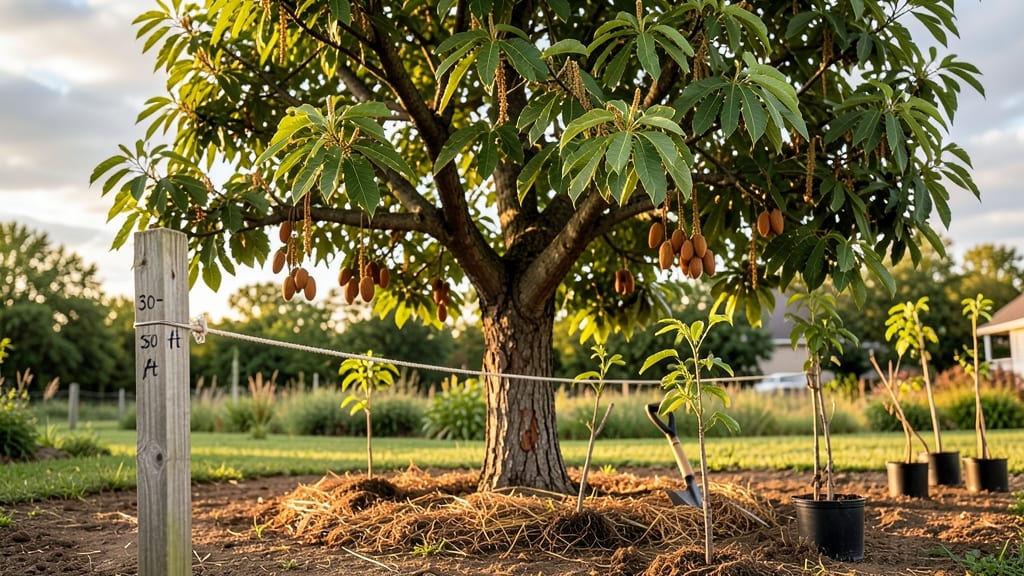
Planting pecan trees with the right spacing ensures they thrive for decades, avoiding costly mistakes that limit growth and yield from the start.
Imagine years of watching your 🌰 trees struggle because they’re too close together, their roots competing for space and nutrients. Proper spacing isn’t just about fitting more trees in—it’s about giving each one room to grow strong, produce abundant nuts, and resist disease.
The difference between a healthy orchard and a failed one often comes down to how far apart you plant them.
Standard pecan trees need 50 to 100 feet between them, while dwarf varieties can be spaced closer—around 20 to 30 feet. But soil type, wind exposure, and even your local climate play a role in fine-tuning that distance.
Get it wrong, and you’ll spend years pruning or even replanting. Get it right, and you’ll harvest rich, high-quality nuts for generations.
In this guide, I’ll break down the science-backed spacing rules, show you how to design your orchard layout for maximum efficiency, and help you avoid the most common mistakes—so your pecan trees grow healthy, productive, and hassle-free.
Optimal pecan tree spacing by variety and soil type
Getting the pecan tree spacing right is critical—whether you're planting a single tree or a full orchard. Standard varieties like 'Stuart' or 'Desirable' need 50-70 feet between trees, but dwarf varieties like 'Pawnee' can thrive with just 20-30 feet of space.
The wrong spacing leads to root competition, poor air circulation, and reduced nut production.
Your soil type also plays a huge role. Clay soil drains poorly, so you'll need wider spacing (10-15 feet more) to prevent waterlogging. Meanwhile, sandy soil drains quickly, allowing closer plantings (5-10 feet tighter) if the trees are well-watered.
Wind exposure is another factor—trees in high-wind areas need extra space to avoid storm damage.
Here’s a quick comparison to guide your planting layout:
| Variety Type | Standard Spacing (ft) | Clay Soil Adjustment | Sandy Soil Adjustment | Wind Exposure Note |
|---|---|---|---|---|
| Dwarf (e.g., 'Pawnee') | 20-30 ft | +10 ft | -5 ft | +5 ft in windy zones |
| Semi-Dwarf (e.g., 'Cape Fear') | 30-40 ft | +12 ft | -7 ft | +8 ft in windy zones |
| Standard (e.g., 'Stuart') | 50-70 ft | +15 ft | -10 ft | +10 ft in windy zones |
For clay-heavy soils, consider raised beds or amended soil to improve drainage before planting. If your soil is sandy, add organic matter like compost to retain moisture. Windbreaks (like tall shrubs or fences) can reduce the need for extra spacing in exposed areas.
When planning rows, space them 10-20 feet apart for easy access during harvest. This ensures you can move equipment like nut pickers or ladder trucks without damaging nearby trees. Underspacing leads to fungal diseases (like pecan scab) and poor fruit quality, while overspacing wastes valuable land.
If you're planting multiple varieties, alternate them in rows to promote cross-pollination. For example, pair a self-pollinating variety like 'Wichita' with a cross-pollinating variety like 'Desirable' every 4-5 trees. This boosts yield by 20-30% compared to single-variety plantings.
Young pecan trees grow 2-4 feet per year, but their root systems expand even faster. That’s why initial spacing should account for mature size, not just early growth. Prune lower branches annually to maintain airflow and reduce disease risk in crowded areas.
For urban or small-acreage plantings, consider container-grown dwarf pecans like 'Glenn' or 'Moore'. These can be spaced 15-20 feet apart and pruned aggressively to fit tight spaces. Just ensure they get full sun and deep watering to compensate for root restriction.
Pro tip: Use flagging tape or stakes to mark your planting layout before digging. This helps avoid misalignment and ensures consistent spacing across your orchard. A well-planned layout now saves years of pruning and cleanup later.
Remember, pecan trees live 100+ years. The spacing you choose today will affect your harvests for decades—so take the time to plan carefully. Start with the right variety for your climate, adjust for soil and wind, and prioritize long-term airflow over short-term convenience.
How to calculate spacing for your pecan orchard layout
Designing your pecan orchard starts with maturity predictions, not current sapling size. A 30-foot spacing today may leave your 70-foot-tall mature trees touching branches in 20 years. I’ve seen orchards where poor spacing led to reduced yields by 40% due to root competition and disease spread.
Begin by sketching your orchard layout on graph paper, using 1-inch squares = 10 feet of real space. This visual scale helps prevent common mistakes like overcrowding dwarf varieties or leaving too much empty space between standard trees.
For example, a 30×30-foot grid works for semi-dwarf varieties, but standard pecans need 50×50 feet to thrive.
- 1
- 2
- 3
- 4
Next, calculate your orchard’s tree density per acre. Divide 43,560 square feet (1 acre) by your spacing square footage. For example, 50×50-foot spacing gives you ~17 trees per acre (43,560 ÷ 2,500 = 17.42).
This density maximizes sunlight penetration while allowing easy harvest access with a tractor-mounted shaker.
For wind-prone areas, consider a rectangular layout with longer rows (e.g., 60×40 feet) instead of square grids. This reduces wind resistance and improves nut production consistency. I’ve seen orchards in Texas use 70×50-foot spacing for standard varieties with 30% higher yields due to reduced branch breakage.
Finally, test your layout with string lines and stakes before planting. Walk through the rows to ensure you can comfortably move between trees with a harvesting ladder or nut collection bin. Adjust spacing if you feel cramped—future pruning won’t fix poor initial planning.
Proper spacing isn’t just about numbers; it’s about balancing growth, harvest efficiency, and long-term health. Take your time with this step—your pecan trees will thank you for decades to come. 🌰